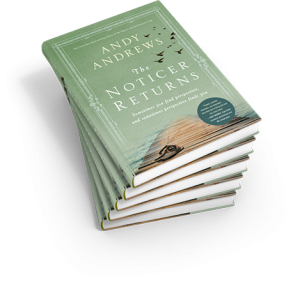
 As you may know, my new book, The Noticer Returns, released this week! In anticipation of release week, my team sat me down and asked a few questions about the book. We discussed everything from common parenting mistakes to unexpected surprises you’ll find as you get further into this new tale about Jones, the Noticer.
Read on, and please ask your own questions in the comments section! I’ll check in throughout the day and answer as many as I can!
P.S.
If you’re interested in getting copies of The Noticer Returns for your friends, family, organization, church, etc., now is the time to do so!
If you get 3 copies or more by October 7, you’ll get my unreleased 4-hour audio program Becoming a Noticer for free. Those ordering a case or more will get 50% off retail price. Go here for all the details.
What is The Noticer Returns about?
The Noticer Returns is about a mysterious old man named Jones who changes the lives of a group of ordinary families. Jones does this by “noticing” little things about people and life that most people miss. He is the “Noticer” to which the title refers. He uses that gift of noticing to give these parents an entirely new perspective on what raising children is all about.
Jones is actually based on a real person I met when I was a homeless 23-year-old living under a pier on Alabama’s Gulf Coast. His name really was Jones (“Not Mr. Jones, just Jones,” he’d always say) and he really did call himself a Noticer. He is one of the main reasons why I’m not still sleeping under a pier today.
Who would benefit from reading this book?
Anyone who wants to provide “the best” for their children, grandchildren, or any children whom they influence.
What exactly is “the best”?
There are many “good”s and “better”s, but there is only one “best.” And that is what Jones challenges several of the book’s characters to define. Curiously, when they do define it, they are left with a list of standards that even people of diverse beliefs can all agree are results they desire their children to have. As for what this list contains, you’ll have to read the book to find out!
Why did you choose to write this book in the form of a story?
Two reasons:
- It’s a lot more interesting to learn and discover real-life principles when they are revealed in the form of a story. Readers get to see the principles played out in the characters’ lives. It’s also a lot easier to convince people to read an entertaining story than any other type of book!
- The smart authors write non-fiction. Ha!
What’s the most important thing parents will learn from this book?
Parents are going to find answers to several questions that they haven’t even thought to ask.
There are so many common occurrences in raising children that people just can’t seem to figure out. For example, we all can think of at least one kid who had great parents, a great family, and an all-around great childhood…who suddenly went crazy as soon as he left the house for college or adulthood. And nobody can figure out how or why it happened!
So the most important thing parents will learn is how to parent according to principles that have already been harnessed by parents who have raised great kids…who go on to become great adults. It’s going to show readers how to pass a way of thinking down to their children so those children actually understand how to make good decisions when mom and dad are no longer around.
What are some unexpected surprises in the book?
Without revealing too much, I’ll say that Jones provides some much needed perspective on one issue that affects a lot of people and one issue that affects all people—Alzheimer’s Disease and death. I won’t say anything more! But I think readers will definitely be surprised in a good way.
What is the most common mistake parents are making?
The biggest mistakes most parents make (and believe me, I’m guilty of these too) seem very inconsequential. They’re little, day-to-day things that, at the moment, don’t seem like a big deal. For example, a few weeks ago I was explaining how to do something to my son, Austin. This was something I had explained before, and something that he didn’t think needed to be explained again, so while I was talking, he said, “I know I know I know.
Now, at that moment, I could have done two things. The convenient thing would have been for me to put an angry look on my face and say, “Don’t speak that way to me. It’s disrespectful and I’m your father and you will respect me.” And that would have been the end of the conversation.
The inconvenient thing to do—which is what I ended up doing—was to explain a few things to Austin:
- Saying, “I know I know I know,” while an adult is talking to you is disrespectful.
- You are not a disrespectful kid, so I would hate for another adult to overhear you speaking to me that way and label you as disrespectful.
- People who are labeled as disrespectful do not get the same opportunities afforded to those who are labeled as respectful.
This slightly longer conversation not only corrected the problem, but it allowed me to show Austin the thinking behind why I was correcting the problem. Now, not only does he know that behavior is disrespectful, but he has a better understanding of why being respectful will benefit him as he gets older.
In the grand scheme of things, this seems like a small deal. And since we’re told over and over not to “sweat the small stuff,” we naturally think it shouldn’t concern us too much. Over time, however, those little things that we gloss over as parents end up painting the bigger picture of our children’s lives as they become adults. And that’s where I think so many parents get tripped up—taking extra time to illustrate their thought process.
What did you learn from writing this book?
I learned that even a small amount of perspective can change our lives. Because even the smallest amount of perspective can change how we are able to navigate hard times.
What questions do YOU have about The Noticer Returns? Leave a comment and I’ll answer as many as I can throughout the day!