For most of human history, people believed that greater connection would bring greater understanding. Technology promised to close the gaps between us. Messages could travel instantly. Photos could be shared across continents. Entire communities could exist without geography.
In theory, this new digital world would knit humanity together in ways earlier generations could never have imagined.
In one sense, that promise was fulfilled. No civilization in history has ever been as linked together as we are today. A person can communicate with hundreds of people before breakfast. News travels globally in seconds. Social media platforms allow us to see, comment on, and react to the lives of people we might never meet in person.
And yet something strange has happened.
Despite being more connected than any society that has ever existed, we are also experiencing a deep and widespread sense of separation. In other words…

What a global pandemic could not accomplish, the tech industry has finally done. We have effectively been Socially Distanced.
Many people feel isolated, fragmented, and overwhelmed by the very systems that were supposed to bring us closer together.
It is not merely that we are distracted by screens. Something deeper appears to be occurring. Our habits of thought, attention, and interaction are being quietly reshaped by the technologies that dominate our days.
There is less reliance on memory or “thinking hard” when one has a device in hand that can provide the answer without taxing our brains.
A growing number of people — particularly younger adults — are beginning to recognize this shift and respond to it. Nearly half of Generation Z now report that they are intentionally trying to reduce the amount of time they spend on their screens.
For a generation that grew up with smartphones in their hands, this is a remarkable admission. It suggests that even those most comfortable with digital life can sense its limits.
This realization is showing up in other ways as well.
Over the past several years, demographic patterns in the United States have begun to change in unexpected directions. For decades, young adults in their prime working years moved overwhelmingly toward the largest cities. Urban centers promised opportunity, culture, and energy.
Curiously, that pattern has recently begun to reverse.
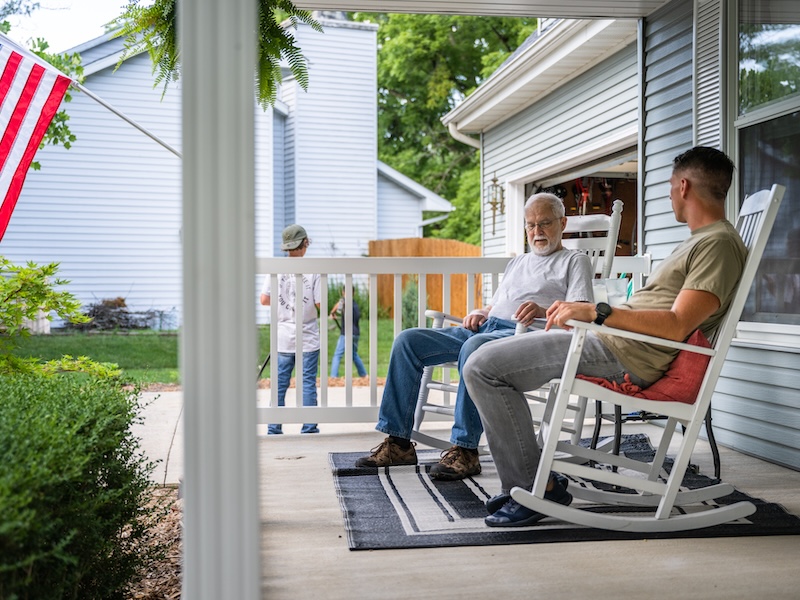
Since 2020, roughly two-thirds of population growth within that same age group has taken place not in major cities, but in smaller towns and rural counties.
It is not an enormous or dramatic migration that dominates headlines. Instead, it is something quieter. Families and young professionals are relocating steadily and deliberately to places with fewer crowds, less noise, and a slower daily rhythm.
What makes this shift particularly interesting is who is making the move. These are not people raised in rural environments who are simply returning home.
Many are millennials and younger professionals who spent years participating fully in the high-speed culture of large cities and digital networks. They experienced the pace, the pressure, and the constant stimulation of modern life. Then, after living inside those systems, they are choosing something different.
They want room to think. They are seeking physical space and emotional breathing room — looking for a kind of life that is not entirely mediated by screens.
It is tempting for observers to immediately interpret this shift through a political lens. In our current climate, nearly every cultural change is quickly framed as a statement of ideology. But the forces driving this movement appear to run deeper than right or left. What we are witnessing looks less like a political reaction and more like a human one.
Throughout history, whenever societies accelerate beyond the pace at which people can find meaning, individuals eventually begin to push back. The response is never loud. It rarely begins with speeches or manifestos. Instead, it starts with quiet decisions made in living rooms and kitchen tables across the country.
A family decides they would rather have a backyard than another apartment upgrade.
A young professional decides that constant notifications are not the same thing as real relationships.
A couple decides they want their children to grow up in a place where neighbors know each other’s names.
None of these decisions are revolutionary on their own. Yet taken together, they suggest something important about the moment in which we are living.
People are not rejecting technology entirely. Few would willingly return to a world without the conveniences modern communication provides. But many are beginning to question whether every aspect of life must be lived at maximum speed and maximum exposure.
They are discovering that connection measured in clicks is not the same as connection measured in presence.
It’s as if we’ve tried it and are now deciding that human beings were not designed to live every waking hour inside a stream of information, opinions, and notifications. Our minds actually require some stillness. Our relationships actually require attention. Our sense of meaning actually requires time alone and offline.
In response, a growing number of people are quietly adjusting the balance.
For the first time in a generation, people are beginning to ask whether constant connection is actually connection at all. They are realizing that attention is a limited resource — and that a life spent scattering it everywhere often leads to meaning nowhere.
So quietly, steadily, they are adjusting course.