

Free printable from Andy: “The Belief Builder” — four simple moves for when your belief in yourself starts to waver.
Has someone ever told you what they really believe is holding them back?
It's hard to get people to answer that question honestly, yet the honest answer holds tremendous value to both the person answering and the person interested in helping.
One of the tools I use to get honest answers to that question is an introductory survey. Whenever someone joins my email list, we automatically send them a survey that helps me get to know who they are, what goals they have, and how I can help them accomplish those goals.
The fourth survey question asks, "What's the biggest problem keeping you from accomplishing your goal?"
It only took a brief scan of recent answers to notice a pattern:
- "Self confidence"
- "Fear of failure"
- "Lack of confidence"
- "I get in my own way"
- "Self-talk"
While confidence and belief in oneself aren't the only topics that come up, they're certainly among the most popular.
Here's the truth: everyone struggles with self-belief at some point in life. And if someone tells you they haven't, they just might be a presidential candidate. (In other words: They're lying. Ha!)
How do I know?
Because strengthening your belief in yourself is a continual trip to the gym—you'll always be lifting weights.
You may have tremendous belief in your mission or your calling, but if you struggle to maintain that same conviction of belief in yourself, there are three keys I want you to remember.
Three Keys to Stronger Self-Belief
1. Your belief comes from your thinking.
This statement is one of the most foundational understandings you can have about what you're trying to build with your life.
We often say that our choices determine where we end up, that they determine our character. That's true to a degree, but it's not the foundation.
The foundation is our thinking.
Remember, every choice you'll ever make is totally determined by what you think, how you think, and how long you think about it. The good news, of course, is you can direct your thinking.
2. You direct your thinking by what you seek…or don't.
God's greatest paradox: your thinking determines your choices…yet you're allowed to choose how you think. You're allowed to choose what you think. And maybe most importantly, you're allowed to choose what you will not think.
Isn't that funny?
Your thinking determines your strength of belief, your lack of belief, your struggle with belief, and your absolute belief. The beautiful thing is you direct your beliefs the same way you direct your thinking.
You direct your thinking by what you CHOOSE to watch, the people you CHOOSE to be around, what you CHOOSE to read, what you CHOOSE to listen to, and where you CHOOSE to place your focus. At the same time, you direct your thinking by what you CHOOSE not to watch, whom you CHOOSE not to spend time around, what you CHOOSE not to read or listen to, and many other things.
3. You have to guard your thinking.

Strong self-belief is not a game you win once and for all. Strong self-belief is constantly dependent upon your thinking. Your thinking is something you must constantly strengthen and protect.
Why? Because belief is a part of your thinking.
Therefore, you must be on alert. YOU are the physical security guard who admits or turns away the people, things, or activities that will influence your thinking. You set boundaries for what you will and will not accept into your life.
Keep this handy. Andy’s free one-page printable, “The Belief Builder,” walks you through the four moves below.
What to Do When Belief Wavers
You may know that 51 publishers rejected my first novel, The Traveler's Gift, for a period of three and a half years. A lot of them didn't say it nicely either.
Here are four things you can do whenever you feel your belief begin to waver. These kept me going through those years of rejection, and I've continued to use them ever since.
1. Speak Your Belief
I had a lot of belief in The Traveler's Gift when I wrote it, but as more and more rejections came my way, maintaining that belief became harder and harder.
One of the first things I would do when doubt started to creep in was to call a trusted friend. He knew his position in my life and I knew my position in his. We were there to encourage each other. I knew that when I called him he was going to say, "Buddy, we've got this—don't worry. This is not a game that has a deadline; this is a game we play until we win."
Occasionally, he would have some doubts, too. He would call me and ask, "Buddy, is this going to happen?" And I would say, "Yes, of course it's going to happen."
We made sure to regularly speak our belief.
2. Seek Proof of Your Belief

In addition to speaking my belief, I would seek out things that would build belief in me. I researched books that had changed the world to see what the process I was enduring had been like for them.
I found that Gone with the Wind had been turned down by 32 different publishers.
Dr. Seuss was repeatedly rejected. Publishers said that children would think his books were ridiculous.
Even The Jungle Book was almost never published. In fact, in one of the many rejection letters Rudyard Kipling received, one "expert" actually wrote, "You simply do not have a grasp of the English language."
Finding that authors much greater than me had experienced what I was currently experiencing was a relief. And this exercise built belief in me.
3. Ask Empowering Questions
Ask questions that remind you why you started trying to do whatever it is you're doing.
For example, I would ask myself, "Is The Traveler's Gift something that will help people who are hurting?"
Yes.
"Is it good for God?"
Yes.
"Is it something that will last, that will stand the test of time?"
Yes.
"Is it something that anybody's done before?"
No.
"Do I feel like this book was put in me for a purpose?"
Yes.
Ask questions that reconnect you with your "why." Write them down. Commit them to your memory.
4. Feed Your Belief Daily
There are many ways to feed your belief in yourself on a daily basis (the previous three tips all help), but one thing I've found useful is the presence of physical reminders.
I both have framed rejection letters from famous publishers for The Traveler's Gift hanging in Wisdom Harbour Studios. They serve as a constant reminder that other people are not the decision makers in our lives.
Always remember this: NO ONE'S negative opinion about your worth and your work contains even a smidgen of actual power. Nothing as transient as what someone else thinks is valuable enough or strong enough to derail your efforts as you strive to accomplish what you have set out to do for your family and the people you want to reach.
What can you do to strengthen your self-belief? What will you choose to think and do to support your sense of purpose? Who and what can you seek for reinforcement? Who can you call when you need encouragement?
Take a few minutes to think about what you want for yourself and your future. What empowering questions can you ask that will help steer you towards a feeling of certainty? Is there a tangible item you can place in your line of sight to remind you to keep going? Don't wait—put it where you can see it daily.
All of these actions when practiced daily will increase your level of belief. I know you can do it. You've got this.
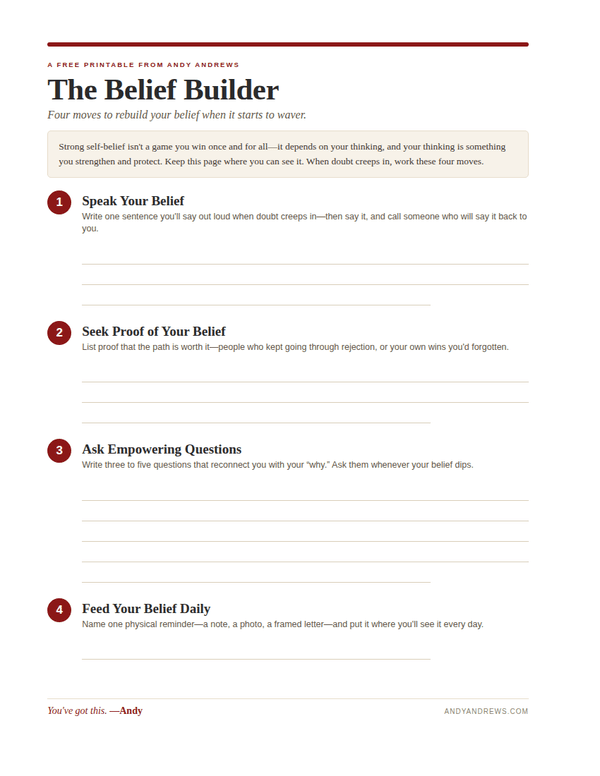
Get "The Belief Builder" — free
When your belief starts to waver, this one-page printable walks you through the four moves above—and gives you space to write the empowering questions that reconnect you with your "why." Join Andy's list and we'll send it your way.