
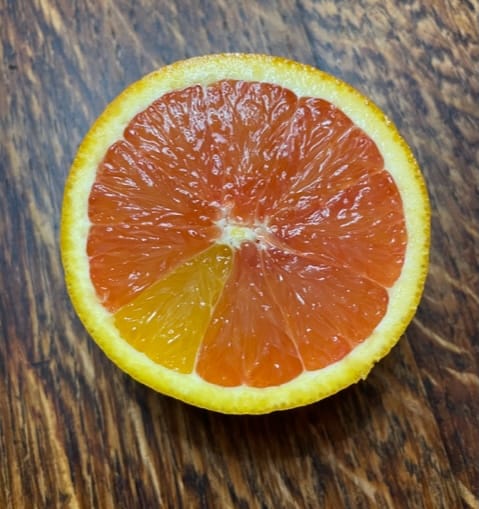
 I bought a bag of oranges at the supermarket and sliced this one open last night.
There was a time when a photograph like this would have stopped a room.
A red naval orange—cut in half, all jeweled crimson flesh—except for one segment glowing bright yellow like a hidden sunrise. Everyone would have leaned closer. A child might have whispered, “How did God do that?”
Now they say, “AI,” or “Nice Photoshop.”
I’ve come to believe that the corner we’ve turned costs us more than we realize. When every image can be manufactured, every color enhanced, every reality adjusted, the miraculous no longer feels like a visitation. It feels like a feature.
There is something missing in our world now that we all assume fabrication before faith. Our old reflex was awe. Our new reflex is suspicion.
I sense increasing tragedy in the fact that we’ve acquired the ability to imitate miracles, because now, we’ve stopped recognizing the real ones.
Real miracles are quieter. They don’t come with software credits. They just sit there—like that single yellow segment—waiting for someone willing to believe what their own eyes are seeing.
We haven’t only lost innocence. Reverence is disappearing, too. When our default assumption is “someone made that,” we subtly deem humanity the highest creative force in the room.
That is too heavy a crown for you and me, because once we expect wonder generated on demand, wonder itself becomes ordinary.
Manufactured miracles must be scalable for investors. If not, the ability to manufacture them is done away with. Divine miracles are singular—and singular things require the humility of attention.
Perhaps that IS what’s truly at risk—not our ability to create astonishing things, but our ability to be astonished. When we stop allowing ourselves to be surprised, we stop allowing ourselves to be grateful. And when gratitude fades, so does joy.
So maybe the quiet rebellion of our time is simple: to look at what we did not design, what we did not edit, what we cannot fully explain—and let it move us anyway.


